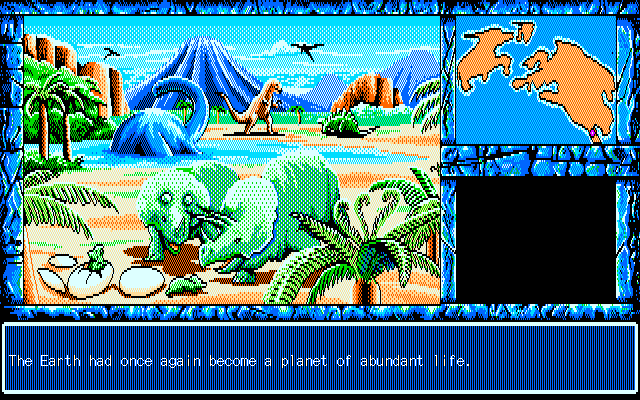
46 Okunen Monogatari -The Shinka Ron-, also known as E.V.O. -The Theory of Evolution- in its English fan-translation, is an underappreciated masterpiece that any self-respecting connoisseur of Japanese RPGs need to play through at least once.
Throughout the game you’re experiencing 4.6 billion years of Earth’s history through the eyes of one single being tasked with embodying the very concept of evolution, hopping from transitional species to transitional species across various eras and calamities through the guidance of Gaia, the embodiment of planet Earth.
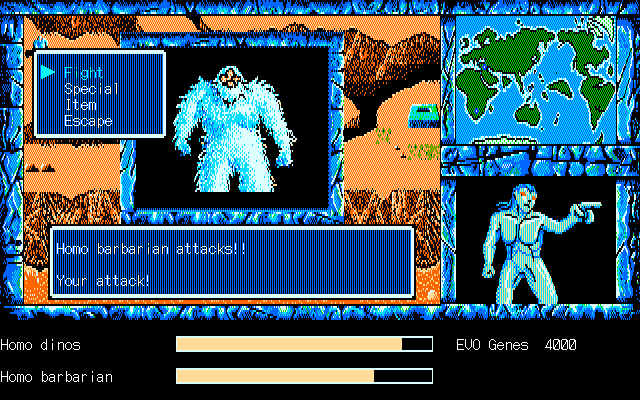
While it’s easy to dismiss the game’s fairly simplistic combat system as not up to the standards of other games of the era, what with it utilising set turn orders that ignore stats in favour of always letting the player act first and sticking to only one-on-one combat encounters, it grows deeper with each evolution through the addition of unique abilities.

Starting as a fish, you can’t do much other than attack or rest, but as soon as you get decent teeth you can bite the opponent, then as you get a prominent tail you can slap them repeatedly in the face, when eventually you get a horn you can stab at them, etc. etc. until finally you’re wielding tools as weapons and using cunning to trick enemies into lowering their guard.
Your evolutionary line is decided through spending experience points, called EVO Genes, on four major stats; wisdom, endurance, vitality and attack. Wisdom determines the effectiveness of special moves, endurance helps you adapt to the environment, vitality determines your maximum health points and attack determines your overall strength.
You need to keep a balance in these stats to not end in an evolutionary dead-end, adding an interesting risk to certain builds. Making bad choices won’t soft-lock you but can cause trouble depending on where you find yourself in the story takes you.
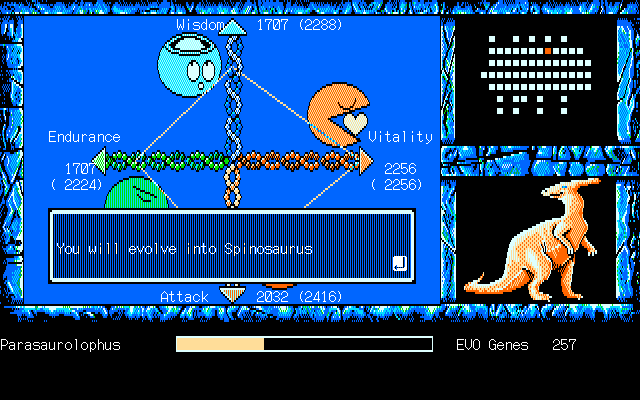
This means that a single playthrough of OkuMono, which took us around 13 hours in total, will not let you experience playing as all the unique species, adding a level of replayability that even some of the deepest RPGs struggle to achieve. There are over 150 different species in total, including some fantastical and fictional ones, and most come with specific abilities befitting their physical traits.
Much like the combat system, the story of OkuMono might initially appear to be very quite simple. You’re a chosen one, who try to do good for the planet and fight a force of evil spreading war and disaster. But what the game manages to do through this simple plot is tell a deeper story about the very concept of how humans categorise good, evil and the nature of the world.
The game is bold enough to tackle subject matters such as the big bang, abiogenesis (the origin of life) and evolution (the diversity of life) while also adding in science fiction details such a panspermia (aliens seeding life on other planets) and discussing the nature of religion, imperialism and environmentalist as the civilisations on Earth form, rise, fall and interpret the world around them.
Despite this the game never feels like it’s talking down to the player. It treats its subject matter with awe and curiosity rather than spite and hostility, even when it depicts something it clearly considers to be morally wrong such as when a civilisation turns to war over misguided leadership from a figure interpreted as an infallible god.
All of it accumulates in what we genuinely believe to be the most jaw-dropping final act of any video game ever made. The fact that the best comparison we can think of when it comes to the scope of the game’s narrative is the amazing masterpiece that is FINAL FANTASY XIV‘s 2021 expansion, ENDWALKER, should speak to the game’s quality as that is literally our favourite game ever made.
Being a lower budget title for the NEC PC-9801 home computer system, there’s not much graphical prowess or detailed animation in the game. The 150+ species are depicted through one still image in the HUD alongside a low-detail 8×8 pixels size sprite that flickers with binary frames of animation for a total of 4 directions. But once again the simplicity does not hurt the game at all.
The drawings themselves are gorgeous, especially the cinematic moments that are sprinkled in throughout the storyline. The game’s colours are vivid, the art style is charming and it all comes together in the best possible way. It’s memorable and does exactly as much as it needs to draw you in.

When it comes to the soundtrack, we have to do something we generally don’t do in reviews. Compliment someone we despise. The music is by the late Sugiyama Koichi, most known for his work on the Dragon Quest franchise. Sugiyama was not someone who cared to not speak ill of the dead, so neither will we.
Sugiyama was a horrible nationalist who repeatedly attacked the families of living, and dead, rape survivors in South Korea. He did this because he was a staunch nationalist who refused to acknowledge the horrible acts of Japan during World War II, and beyond, towards the Korean people.
He was also notorious for refusing to let his, mostly mediocre, music be available for western audiences leading to Dragon Quest games often being localised with midi soundtracks instead of fully orchestrated ones.
Even before we learned of Sugiyama’s ideological stances, we found it strange that he was such a hugely popular composer since much of his work is frankly not that good. There are a few great tracks from Dragon Quest, for sure, but most of it is just not that memorable. He’s no Shimamura (Kingdom Hearts, Super Mario RPG), Soken (FFXIV) or Uematsu (you know), that’s for sure.
However. This is where we have to swallow our pride and admit something. This game’s soundtrack kicks ass. It is by far the best work Sugiyama has ever put out and it genuinely should be up there with the most celebrated examples of video game soundtracks.

Which is why it’s such a shame that this game is likely never going to see any kind of re-release. Despite efforts from groups such Project EGG that strive to make old Japanese home computer games playable on modern computers and Nintendo Switch, it’s not likely to happen specifically because it’s a game with Sugiyama’s music and the legal details around it is a hellscape. We hope we’re wrong there, because the game and its soundtrack deserves more of an audience.
The saddest part of finishing 46 Okunen Monogatari -The Shinka Ron- was realising that there’s no other game like it. Its Super Nintendo sequel, which did release in the west, is vastly different and games like Spore, Pokémon or certain Digimon games might scratch some parts of the itch but not enough to feel as a satisfying alternative.
We need more games like this.
Score: 9/10
We played through the entirety of 46 Okunen Monogatari -The Shinka Ron- on stream for the Jurassic June 2025 event. You can watch it and many more streams on our YouTube channel!
 Lesbiandrea!